
The Battle of Mists (1651)
Where Blood and Stone Were Forged
Prologue: The Gathering Storm of 1651
The mid-17th century in Scotland was a canvas painted in turbulent greys and violent reds. It was an era where the very air seemed heavy with the threat of conflict, and the rugged beauty of the Highlands offered little sanctuary from the chaos engulfing the nation. Yet, amidst this widespread upheaval, Clan Tolguhoun stood apart, anchored by a legacy established over two centuries prior.
They were a people defined by the union of opposites. Since 1420, their identity had been shaped by the marriage of the jagged granite peaks of the High Crag and the lush, herb-filled glens of the Low Valleys. They were builders of stone fortresses like Preston’s Tower, symbolising unyielding defence , but they were also masters of the Stillroom Gardens, the castle’s heartbeat, where the secrets of the earth were cultivated.
By 1651, this dual heritage was about to be tested in the crucible of war. The clan faced a threat that required more than just the brute strength of their granite walls. The impending conflict, which history would remember as the Battle of the Mists, threatened to wither the very heritage they were mandated to protect.
The Hero: Sir Alexander Duncreag
In this hour of darkening horizons, the leadership fell to Sir Alexander Duncreag. Sir Alexander was the living embodiment of his clan’s philosophy. He carried the Stone-Strong resilience of his ancestors in his bearing, a warrior prepared for hard defence. Yet, he possessed a wisdom that extended beyond the blade.
He understood that true strength was not merely physical; it was also derived from the land they inhabited. He knew the secrets hidden within the Stillroom Ledgers, the repository of botanical knowledge passed down through generations. Sir Alexander recognised that to survive the coming storm, his kin would need to draw upon the restorative power of nature just as much as their martial prowess. He was a leader who understood that the Blood of the Earth—the potent botanicals cultivated by the clan—could be wielded as a tactical advantage.
The Crucible: Cloaked in White Darkness
The battle met them not in clear sunlight, but enveloped in a suffocating, chilling fog that rolled down from the peaks, giving the conflict its legendary name. The mist reduced the world to a few terrifying feet in front of every warrior’s face. It was a blinding white darkness that amplified every sound—the ringing of steel, the cries of men, the damp thud of boots on heather—into a disorienting cacophony.
In such conditions, an army’s greatest enemy is often its own fear and confusion. The physical might of Preston’s Tower felt distant; the unyielding defence of stone walls could not help them out in the open glens. Morale began to fray as the unseen enemy pressed their advantage, the damp chill seeping into the very bones of the Tolguhoun warriors. They needed a lifeline, something to anchor them amidst the swirling chaos.
The Turning Point: The Secret Weapon
It was in this moment of supreme crisis that Sir Alexander Duncreag deployed his secret weapon. It was not a new devastating engine of war, nor a reinforcement of troops. It was the distillation of centuries of Stillroom wisdom.
Sir Alexander moved among his beleaguered force, distributing a potent tincture. It was a formulation born of the Blood of the Earth, crafted from ingredients like Wild Thyme and Honey. This was not merely sustenance; it was tactical botanical power.
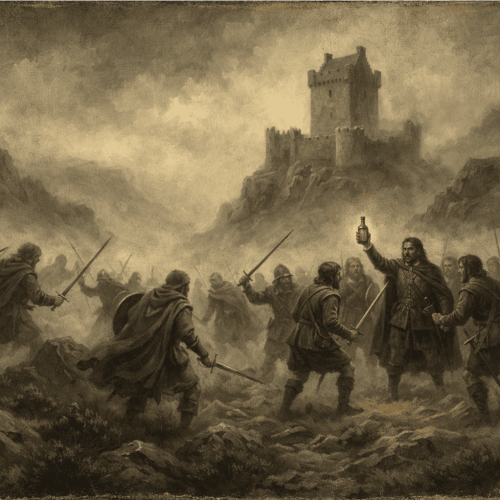
The effect was visceral. The tincture was designed with a specific, urgent purpose: to sharpen the senses and bolster the courage of men pushed to their breaking point. As the warriors partook of the honeyed, herbaceous draught, a shift occurred. The mist did not lift, but the fog in their minds cleared. The paralysing grip of fear loosened, replaced by a cold, stone-strong resolve.
The wild thyme, resilient enough to grow in the cracks of castle granite, imparted that same resilience to the men. A renewed energy surged through their ranks. The confusion that had threatened to rout them was replaced by a hyper-aware focus. They could hear the enemy’s approach with newfound clarity; their sword arms felt lighter, their hearts steadier.
The Legacy: Blood and Stone Forged
The Battle of the Mists became a legendary defence, a testament to the clan’s ability to survive through a unique combination of hard defence and natural restoration. They held the line, protected by their leader’s foresight and the potent legacy of their land.
But the true victory of 1651 extended far beyond the battlefield. That foggy day was the forge where the tradition of Blood and Stone was truly created. It was the moment the abstract philosophy of the 1420 union became a visceral, life-saving reality. The stone represented their unyielding defensive strength, mirroring their fortress, while the blood was the revitalising botanical power of the earth that sustained them.
This battle became the emotional core of Clan Tolguhoun’s identity. It proved that their heritage—a legacy that refused to wither—depended on the balance of Fortis et Natura, Strength and Nature. Sir Alexander Duncreag’s actions cemented the belief that true preservation lay not just in the might of the sword, but in the wisdom of the soil.