
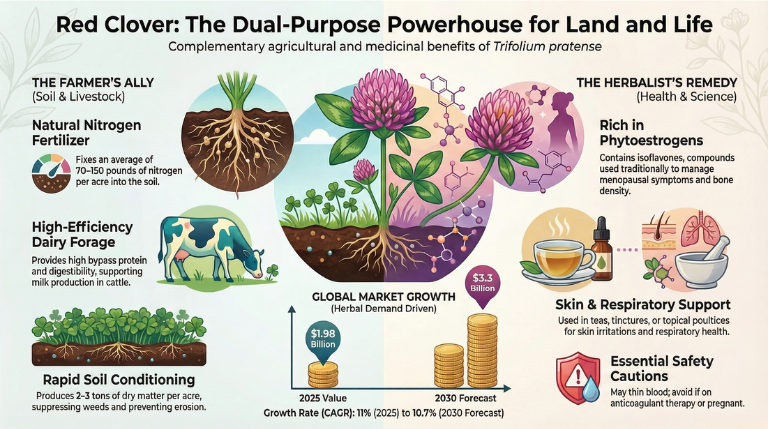
Red clover (Trifolium pratense) is a herbaceous, short-lived perennial plant belonging to the legume family (Fabaceae), the same family as peas and beans. Recognized for its pink-to-red bristled blossoms and trifoliate leaves, it is native to Europe, Western Asia, and Northwest Africa but has naturalized globally, including in the Americas and Australasia.
Botanical Classification
- Scientific (Latin) Name:Trifolium pratense L..
- Kingdom:Plantae.
- Family:Fabaceae.
- Genus:Trifolium.
- Common Names:Cow clover, meadow clover, wild clover, and pink-bristled blossom.
Parts of the Plant Used
Different parts of the red clover are utilized depending on the application:
- Flowering Tops (Blossoms):These are the most nutrient-dense parts and are preferred for high-quality herbal teas, tinctures, and medicinal extracts.
- Leaves:Young leaves are edible and can be eaten raw in salads or cooked.
- Whole Herb (Leaves and Stems):Often used in raw form for agricultural forage or lower-grade herbal preparations.
- Roots:The deep taproot system is valued for soil conditioning and drought tolerance.
- Seeds:Used for planting as cover crops or for seed production.
Benefits and Uses
Red clover serves a wide variety of functions, ranging from large-scale agriculture to personal health.
- Agricultural and Environmental Uses
- Nitrogen Fixation:Like other legumes, it converts atmospheric nitrogen into soil nutrients, producing an average of 70–150 pounds of nitrogen per acre.
- Cover Crop and Green Manure:It is used to suppress weeds, prevent soil erosion, and improve soil organic matter.
- Livestock Forage:It is a high-protein feed for cattle and dairy cows, though farmers must manage it carefully to prevent bloat.
- Wildlife Support:It provides nectar for pollinators like bumblebees and serves as a food source for deer, turkeys, and rabbits.
- Medicinal and Health Benefits
- Menopausal Symptoms:It contains isoflavones (phytoestrogens), which are compounds similar to oestrogen.
- Skin Health:It is used topically or as a tea to treat skin irritations and inflammation.
- Bone Health:Some use it to help preserve bone mass and density, particularly for those concerned with osteoporosis.
- Respiratory Support:Historically, it has been used as an expectorant to treat coughs, bronchitis, and asthma.
- Culinary and Other Uses
- Edible Garnish:Flowers and leaves can be added to dishes or ground into flour.
- Tisanes and Jellies:The flowers are frequently used to make jellies and herbal teas.
- Aromatherapy:Essential oils can be extracted from the flowers for their unique scent.
Potential Side Effects and Cautions
While generally considered safe for short-term use in adults, there are important considerations:
- Hormone Sensitivity:Due to its oestrogen-like compounds, long-term use may pose risks for women with hormone-sensitive conditions, such as breast or uterine cancer. Its safety for pregnant or breastfeeding women is unclear.
- Blood Thinning:Red clover contains coumarin derivatives that can thin the blood. It should be avoided by individuals on anticoagulant therapy or those with coagulation disorders.
- Drug Interactions:It is metabolized by the enzyme CYP3A4, meaning it may interact with other medications that use the same metabolic pathway.
- Livestock Bloat:If used as grazing pasture, it can cause bloat in cattle if not managed correctly.